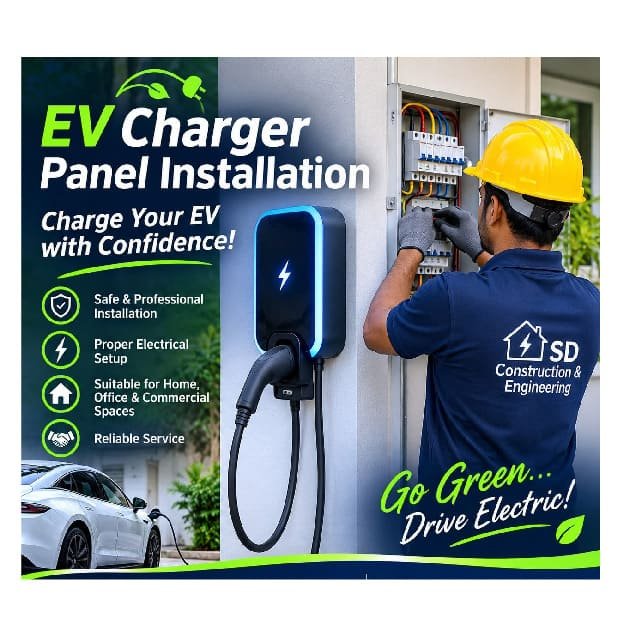
SD Construction EV Charger Installation
Posted on 2026/11/25 - 10:33 AM, Piliyandala, Colombo

Details
SD Construction and Engineering 076 269 6806 is a trusted provider of professional EV charging panel installation services in Piliyandala and neaby areas in Colombo Sri Lanka. With extensive experience and numerous successfully completed projects across Piliyandala and Colombo, the company delivers reliable and efficient electrical solutions to meet the growing demand for electric vehicle charging infrastructure. Specialising in EV charging panel installation, the team focuses on quality workmanship, safety, and customer satisfaction. Whether you require an EV charging panel for a commercial property, office building, apartment complex, or private premises, We professional EV installation solutions tailored to your requirements. With a commitment to high standards and dependable service, the company helps businesses and property owners establish convenient and reliable EV charging facilities.
EV Charging Panel Installation Process in Sri Lanka
The growing popularity of electric vehicles (EVs) in Sri Lanka has created an increasing demand for reliable and efficient electric vehicle charging infrastructure. As more individuals, businesses, and organisations move towards environmentally friendly transportation, the installation of EV charging panels has become an important part of the country's transition to sustainable mobility. A properly installed EV charging panel ensures safe, efficient, and convenient electricity distribution to electric vehicle charging stations. Whether it is a residential property, commercial building, hotel, shopping complex, office premises, or public charging station, professional installation is essential to ensure reliable operation and electrical safety.
1. Initial Site Inspection and Assessment
The first step in the EV charging panel installation process is conducting a detailed site inspection. A qualified electrical engineer or experienced EV charging installation technician visits the proposed location to assess its electrical infrastructure and installation requirements.
During this inspection, several factors are considered, including the available electricity supply, existing distribution board capacity, distance between the main electrical supply and the charging point, cable routing possibilities, parking arrangements, and available installation space.
In Sri Lanka, particular attention must be given to whether the property has a single-phase or three-phase electricity supply. The electrical demand of the proposed EV charging equipment must be compared with the existing supply capacity to determine whether any upgrades are necessary.
2. Electrical Load Calculation and Power Requirements
After the site inspection, the next step is calculating the electrical load requirements. Different electric vehicles and charging equipment have different power requirements. Therefore, the charging panel must be designed according to the expected electrical demand.
For example, residential AC chargers commonly operate at approximately 3.7 kW or 7.4 kW, while higher-capacity commercial AC chargers may operate at 11 kW or 22 kW, depending on the supply arrangement and vehicle compatibility.
The electrical engineer evaluates the total connected load, maximum demand, existing building consumption, and available electricity capacity. This assessment helps determine whether the existing electrical connection can support the additional charging load.
If the existing supply is insufficient, an electricity supply upgrade may be required. Depending on the circumstances, coordination with the relevant electricity provider, such as the Ceylon Electricity Board (CEB) or Lanka Electricity Company (LECO), may also be necessary.
3. Designing the EV Charging Distribution Panel
Once the electrical requirements are confirmed, a suitable EV charging distribution panel is designed. This panel acts as the main electrical distribution and protection system for the EV charging equipment.
A properly designed EV charging panel generally includes:
-
Main incoming circuit breaker.
-
Individual outgoing circuit breakers for charging points.
-
Residual Current Device (RCD) or appropriate residual current protection.
-
Surge Protection Device (SPD), where required by the design.
-
Proper earthing and grounding arrangements.
-
Busbars and neutral connections.
-
Electrical indicators and monitoring components, where applicable.
-
Suitable enclosure with appropriate protection against environmental conditions.
The panel must be designed according to the charging equipment manufacturer's specifications and applicable electrical safety standards. Proper circuit separation and protection help prevent electrical overloads, short circuits, and earth leakage faults.
4. Selecting Suitable Electrical Components
Selecting high-quality electrical components is essential for the long-term performance and safety of an EV charging installation. Since EV chargers can operate for several hours continuously, all electrical components must be capable of handling the required load.
The main circuit breaker, miniature circuit breakers, residual current protection devices, contactors, busbars, cables, and other accessories must be selected according to the calculated electrical load.
Special attention should be given to residual current protection. EV charging equipment may require Type A protection combined with 6 mA DC residual current detection, or Type B protection, depending on the charger's built-in protection features and applicable standards.
Using certified electrical components from reliable manufacturers helps improve system reliability and reduce maintenance requirements.
5. Cable Selection and Installation
Cable selection is another important stage of the installation process. The cable size must be calculated according to the charger's power rating, installation distance, current-carrying capacity, voltage drop, ambient temperature, and installation method.
In Sri Lanka, electrical installations may be exposed to high temperatures, humidity, heavy rainfall, and other environmental conditions. Therefore, suitable insulation, cable protection, and installation accessories should be selected.
Cables are routed through suitable conduits, cable trays, trunking, or underground ducting, depending on the site requirements. All connections must be properly terminated and secured to minimise overheating and electrical faults.
6. Installing the EV Charging Panel
After preparing the installation area and completing the necessary cable routing, the EV charging panel is installed at the designated location.
The panel should be mounted securely in an accessible position, protected from direct rain, excessive heat, water ingress, and physical damage. For outdoor installations, a suitable weather-resistant enclosure with an appropriate IP rating should be selected.
The incoming power supply is connected to the main breaker, while outgoing circuits are connected to the respective EV charging points. Proper labelling of breakers and electrical circuits is also important for future maintenance and troubleshooting.
All installation work should be carried out by suitably qualified and competent electrical professionals.